Detecting Abnormal Markets: Early Warning Systems
A machine learning system that detects early warning signs of market instability by analyzing 43 financial indicators and categorizing anomalies as Risk-on or Risk-off signals.

F1 Score
Recall Rate
Indicators
Anomalies Detected
Problem & Solution
Early detection of market instability
The Challenge
Market anomalies are rare but critical events. Traditional monitoring systems often fail to detect early warning signs, leading to significant financial losses. The challenge lies in identifying these rare events within highly imbalanced datasets where normal observations vastly outnumber anomalies.
The Objective
Build an automated early warning system that detects market instability in real-time, rather than attempting long-term crisis prediction. The system needed to analyze multiple financial indicators simultaneously and categorize anomalies by their risk profile.
Dataset Characteristics
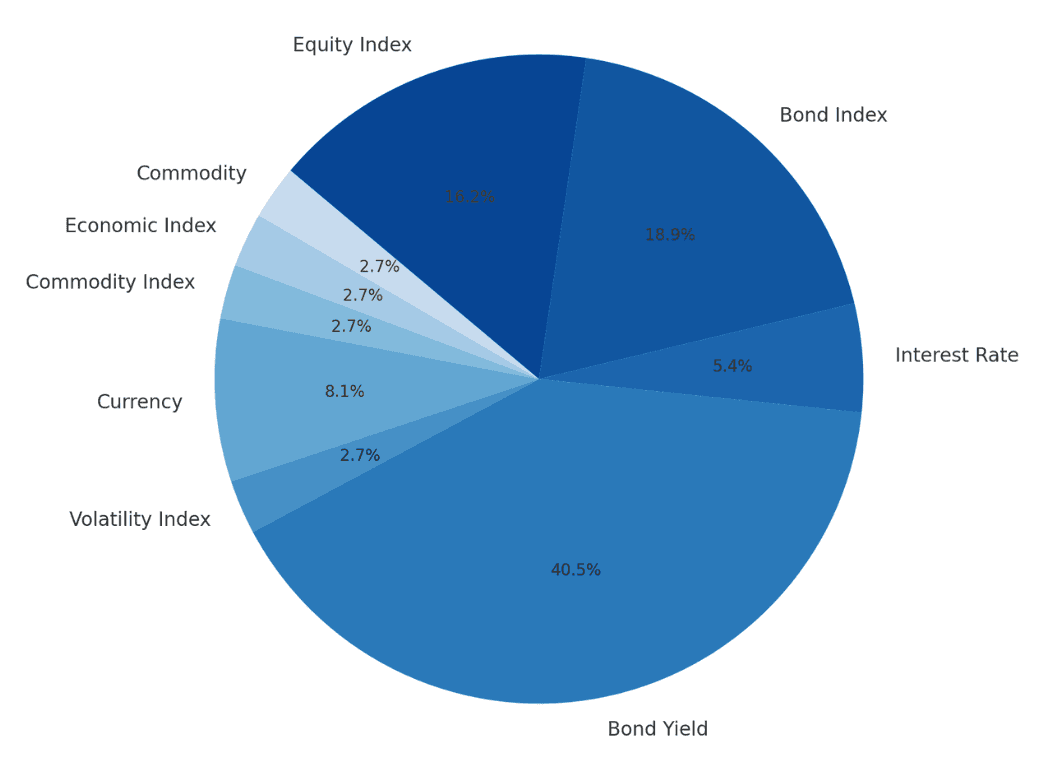
43 financial indicators spanning bonds, equity indices, and currencies
Highly imbalanced with few anomalies among many normal observations
Temporal dependencies requiring sequential pattern recognition
43 Financial Indicators by Category
Anomaly Classification
Bullish market signals
Bearish market signals
43 Financial Indicators Distribution
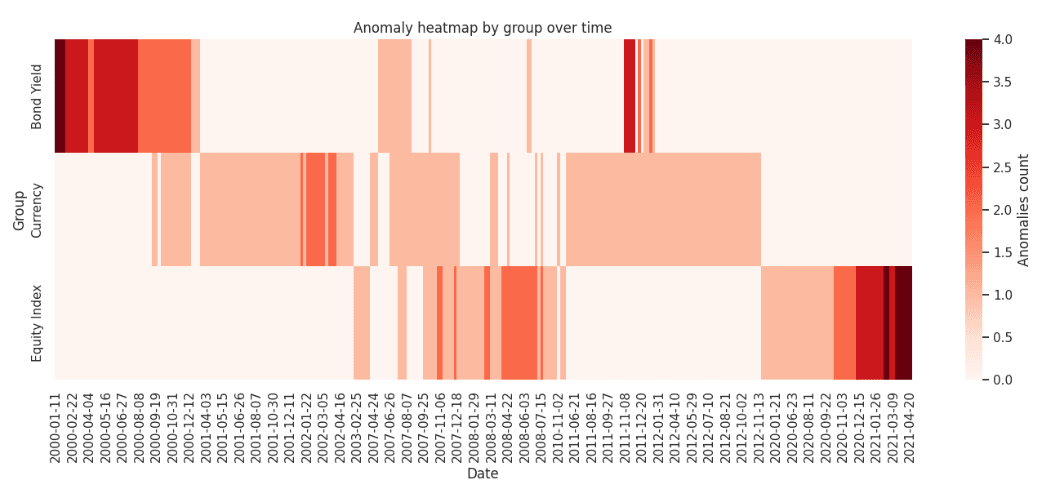
Anomaly Heatmap by Group Over Time
Methodology
Data preprocessing and anomaly detection approach
Data Preprocessing
- Stationarity transformation
- Temporal splitting (80/10/10)
- Standardization (mean/std)
Anomaly Detection
- Deviation from mean/std
- Risk-on/off categorization
- 3-day lookback window
Risk Group Analysis
- Equity Index (Highest)
- Bond Yield (High)
- Currency (High)
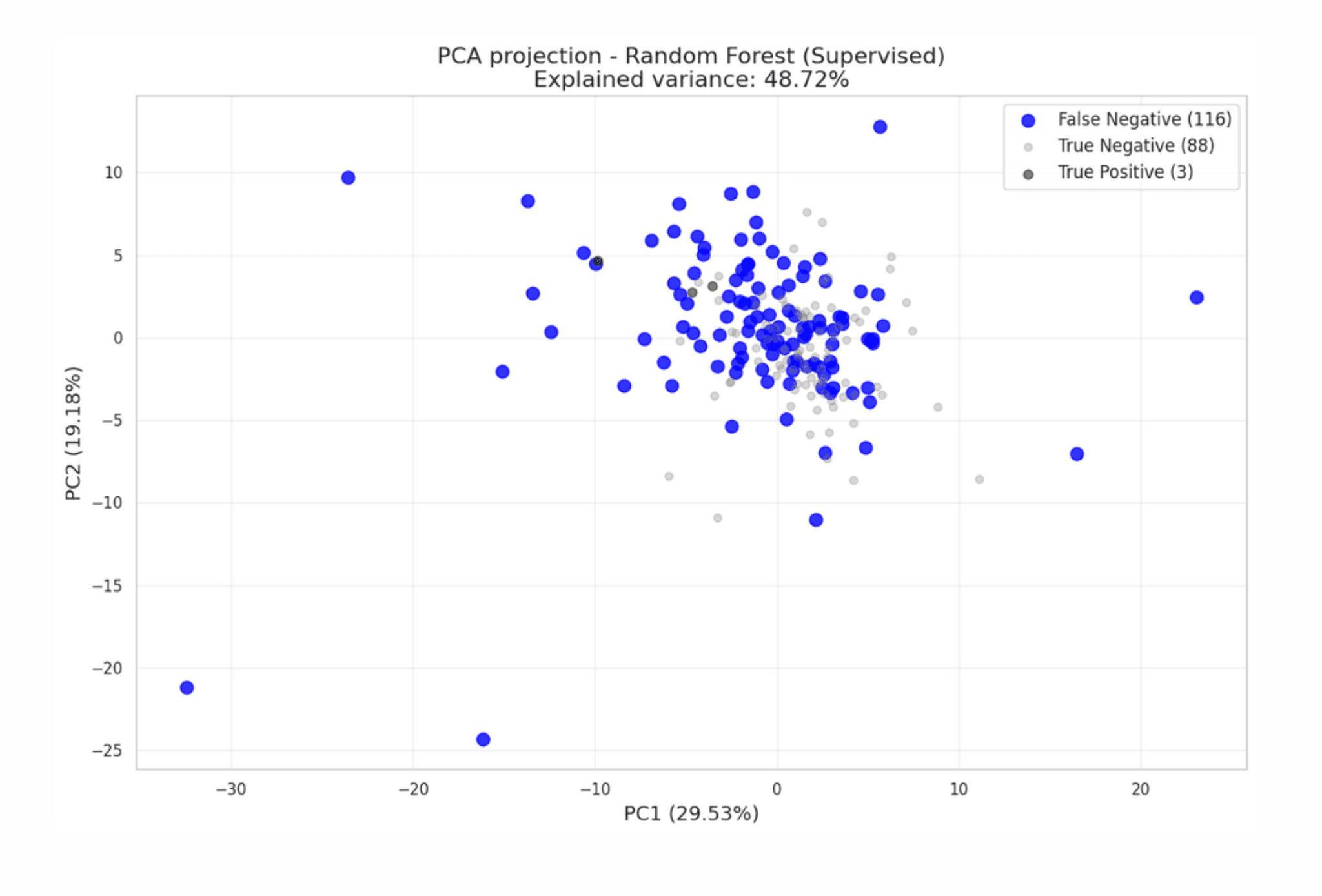
Random Forest PCA Projection for Supervised Learning
Model Performance
Comprehensive comparison across 8 machine learning approaches
| Model | Precision | Recall | F1 Score |
|---|---|---|---|
| LSTM Autoencoder + Active Learning | 0.8252 | 0.9916 | 0.9008 |
| Ensemble (AE + XGBoost + LOF) | 0.7426 | 0.8487 | 0.7922 |
| XGBoost | 0.7661 | 0.7983 | 0.7819 |
| Multivariate Gaussian | 0.6031 | 0.9832 | 0.7476 |
| COPOD | 0.6692 | 0.7479 | 0.7063 |
| LSTM | 0.6960 | 0.5520 | 0.6150 |
| Optimized Random Forest | 0.9444 | 0.2857 | 0.4387 |
| Random Forest | 1.0000 | 0.0252 | 0.0492 |
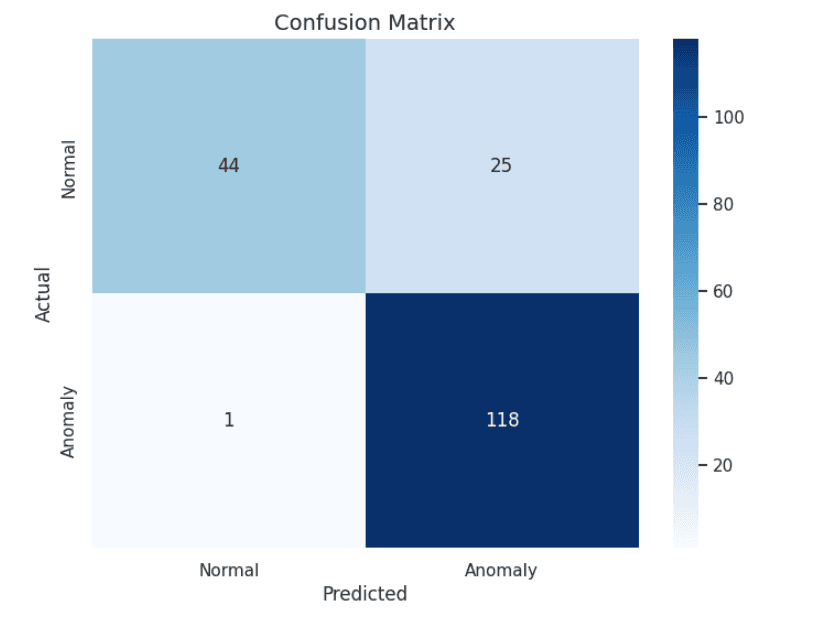
Confusion Matrix - LSTM Autoencoder
Winning Model
LSTM Autoencoder with Active Learning
The champion model achieved 90% F1 score and detected 118 out of 119 anomalies in the test set through innovative semi-supervised learning.
Architecture Details
Stacked LSTM layers with hidden size 64 for capturing temporal dependencies
Latent dimension 8 for compressed representation learning
Dropout & batch normalization to prevent overfitting on limited anomaly samples
3-day lookback window captures immediate market momentum while filtering noise
Key Innovation: Active Learning
The model employs a semi-supervised active learning approach that iteratively selects high-error sequences as pseudo-anomalies. This technique effectively addresses the challenge of limited labeled anomaly data.
Process: The autoencoder identifies sequences with high reconstruction error, treats them as potential anomalies, and retrains iteratively. This bootstrapping approach significantly improved recall without sacrificing precision.
Final Performance Metrics
Key Insights
Why LSTM Autoencoder won
Temporal Patterns Are Crucial
Financial markets exhibit strong sequential dependencies. LSTMs excel at capturing these temporal patterns, making them ideal for detecting anomalies that unfold over time rather than appearing as isolated events.
Active Learning Overcomes Data Scarcity
With only ~119 anomalies in the test set—far below what neural networks typically require—active learning proved essential. By iteratively identifying and learning from high-error sequences, the model effectively expanded its training data.
Random Forest Severely Overfitted
Despite achieving 100% precision, Random Forest's recall of only 2.52% revealed severe overfitting. The model memorized training anomalies but failed to generalize, highlighting the importance of temporal modeling in this domain.
Ensemble Underperformed
Surprisingly, the ensemble (AE + XGBoost + LOF) achieved lower F1 score (79.22%) than the standalone LSTM Autoencoder (90.08%). This suggests that combining models with different strengths can sometimes dilute the best performer.
Limitations & Challenges
Trade-offs and constraints
The Interpretability Problem
While LSTM Autoencoder achieved the best performance, it operates as a "black box." Finance professionals need to understand why a model flags specific market conditions as anomalous, which is challenging with deep learning architectures.
Limited Anomaly Samples
The dataset contained only ~119 anomalies in the test set. Neural networks typically require thousands of examples to learn robust patterns. Active learning helped but doesn't fully compensate for fundamental data scarcity.
Computational Requirements
LSTM Autoencoders require significantly more computational resources for training and inference compared to traditional methods like Multivariate Gaussian. This impacts real-time deployment costs.
Window Size Sensitivity
The 3-day lookback window was optimal for this dataset, but different market conditions or asset classes might require different window sizes. The model needs retuning when applied to new contexts.
Future Work
Recommendations for next iterations
Ensemble with Bootstrapping
Extend the ensemble approach with bootstrapping techniques on larger datasets. This could capture diverse anomaly patterns while maintaining the temporal modeling strength of LSTMs.
Explainability Layer
Develop an explainability framework using attention mechanisms or SHAP values to interpret LSTM predictions. This would make the model more trustworthy for financial decision-makers.
Continuous Learning Pipeline
Implement an active learning workflow for continuous model refinement as new market data arrives. This would keep the model current with evolving market dynamics.
Interested in financial AI solutions?
Let's discuss how we can build custom anomaly detection systems for your specific needs.